
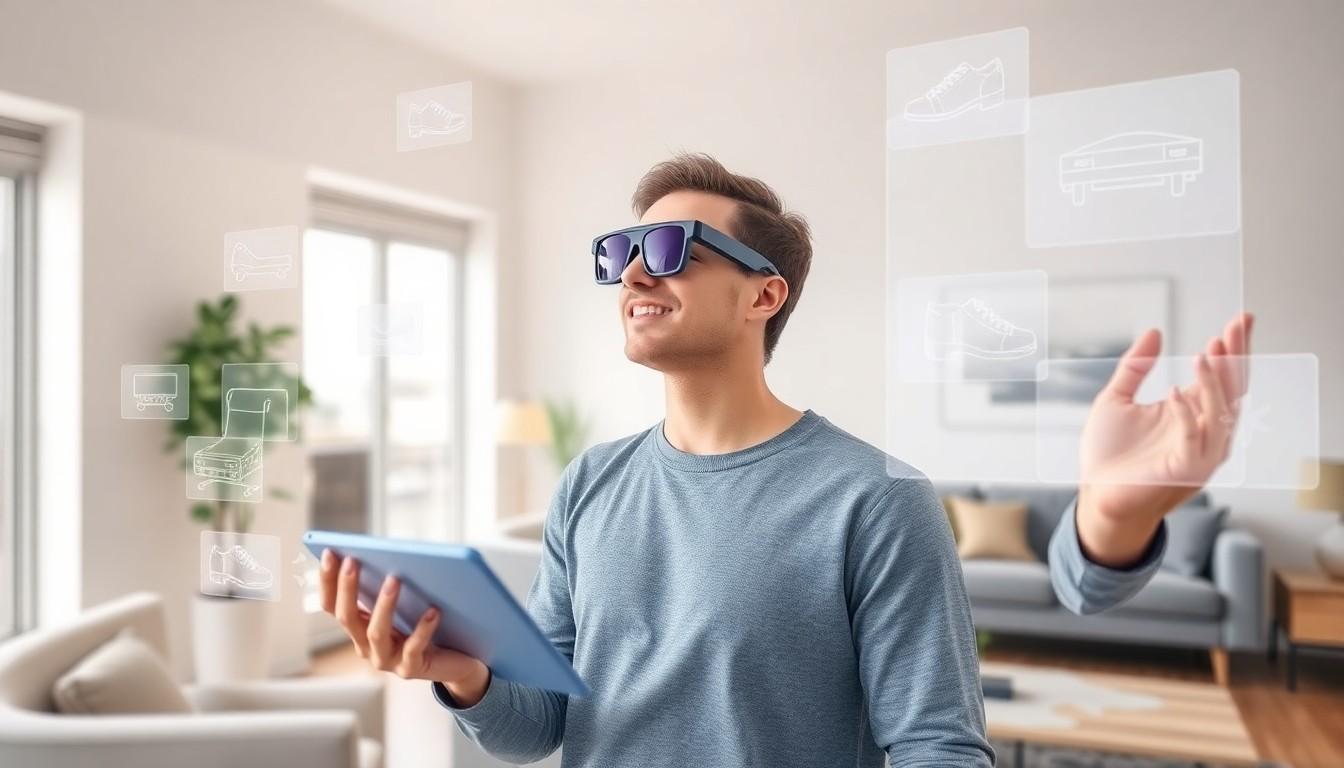
Augmented Reality (AR) is like magic, but without the rabbits or top hats. It seamlessly blends the digital world with our reality, creating experiences that can leave anyone saying, “Wow, did that just happen?” From gaming to shopping, AR transforms the mundane into the extraordinary, making everyday tasks feel like an adventure.
Imagine trying on shoes without leaving your couch or seeing how that new couch fits in your living room before you buy it. With AR, it’s not just a dream; it’s the new normal. This technology isn’t just for tech enthusiasts; it’s for anyone who wants to make their life a little more fun and a lot more interactive. Dive into the world of AR, where reality gets a digital upgrade, and discover how it’s changing the way we see the world—one pixel at a time.
Overview of Augmented Reality
Augmented Reality (AR) significantly enhances experiences by merging digital content with the physical environment. This blend allows users to interact with both realms seamlessly.
Definition of Augmented Reality
Augmented Reality refers to technology that overlays digital information onto the real world. Applications utilize devices, such as smartphones, tablets, or smart glasses. Through AR, users view their surroundings enhanced with graphics, sounds, and other sensory stimuli. An example includes mobile apps that project 3D models into a user’s environment, facilitating interaction. This technology stands apart from Virtual Reality, which creates entirely immersive environments.
Importance of Augmented Reality in Today’s World
Augmented Reality plays a vital role in various sectors, enhancing how people gather information. In retail, customers use AR to visualize products before purchasing, reducing uncertainty. Education benefits from AR by providing interactive learning experiences; students engage with complex concepts through visual aids. Additionally, industries like healthcare apply AR for training purposes, allowing professionals to practice in simulated settings. As AR continues to evolve, its applications become more versatile and helpful, significantly impacting daily activities.
Examples of AR Applications

Augmented Reality (AR) applications transform experiences across various sectors. Users interact with digital elements seamlessly integrated into their physical surroundings.
AR in Gaming
AR in gaming creates immersive experiences that blend virtual characters with the real world. Popular titles like Pokémon GO encourage players to explore their environment while capturing Pokémon. This engagement fosters physical activity and social interaction. Players communicate and collaborate to achieve in-game objectives. Those familiar with AR games notice how this technology enriches gameplay, offering new layers of enjoyment.
AR in Education
AR in education enhances learning through interactive and engaging experiences. Students utilize AR apps to visualize complex concepts, such as anatomy or geometry. Classrooms become dynamic environments where learners explore subjects in depth. Teachers incorporate AR into lessons, making difficult topics more relatable and understandable. As a result, students become more engaged, leading to improved retention of information.
AR in Retail
AR in retail revolutionizes shopping by allowing users to visualize products in their own spaces. Apps enable customers to see how furniture fits in their homes before purchasing. Similarly, virtual try-ons let shoppers experience how clothes or accessories look without physical contact. Retailers benefit from increased customer satisfaction and reduced return rates. Innovative applications continue to emerge, enhancing the overall shopping experience.
Benefits of Using AR
Augmented Reality (AR) offers significant advantages across various sectors, enhancing everyday interactions and business operations.
Enhanced User Experience
AR provides users with tailored experiences that facilitate informed decisions. Shoppers can visualize products directly in their environments, eliminating uncertainty. For instance, customers trying on clothing or accessories virtually reduces disappointment from mismatches. Students benefit from interactive learning, engaging with complex subjects through visual simulations. Enhanced experiences foster greater satisfaction, leading to stronger brand loyalty.
Increased Engagement
User engagement significantly increases when AR elements are integrated into activities. AR transforms passive experiences by inviting users to interact dynamically with content. For example, gamers actively participate in immersive environments that blend virtual elements with real-world settings. Educational apps employ AR to enrich lessons, capturing students’ attention and promoting active participation. This amplified engagement results in deeper connections and improved content retention.
Opportunities for Businesses
Businesses encounter unique opportunities with AR technology adoption. Retailers can create engaging campaigns that attract customers, inspiring them to interact before making purchases. AR applications provide innovative marketing strategies, allowing brands to showcase products in real time. Moreover, companies that utilize AR often see reductions in return rates, as consumers make more informed choices. The accessibility of AR opens new avenues for business growth and customer interaction.
Challenges and Limitations of AR
Augmented Reality faces several challenges and limitations that can hinder its full potential.
Technical Limitations
Technical hurdles present significant issues for AR effectiveness. Limited battery life in devices restricts prolonged use, affecting user experience. High processing power is often required for AR applications, which can strain older smartphones and wearables. Not all environments are suitable for AR; poor lighting and complex backgrounds can disrupt the overlay of digital content. Connectivity issues can arise, particularly in areas with weak internet signals, impacting real-time data retrieval. Additionally, the accuracy of AR systems depends heavily on precise location tracking, which sometimes fails. These factors contribute to an inconsistent user experience that can deter widespread adoption.
User Privacy Concerns
User privacy presents another major concern in the AR landscape. Many AR applications collect personal data to enhance experiences, raising issues around how this information is utilized. Users may fear that shared data could lead to surveillance or misuse, fostering distrust. The integration of cameras and sensors in AR devices amplifies concerns about data security, prompting scrutiny from privacy advocates. Lack of transparency regarding data management policies can further exacerbate user apprehension. Therefore, developers must prioritize privacy to build trust and encourage users to engage with AR technology confidently.
Future Trends in Augmented Reality
Augmented Reality is on the brink of exciting advancements. Innovations are emerging that are set to redefine user experiences and expand the technology’s applications.
Innovations on the Horizon
Wearable AR technology, such as smart glasses, is gaining traction. These devices offer hands-free access to information and improve user engagement. Immersive interfaces are being developed that enhance interaction with digital content. Improved computer vision algorithms make AR experiences more seamless and user-friendly. Companies are exploring the integration of Artificial Intelligence to personalize AR content in real-time. With developments in 5G connectivity, latency issues will decline, enhancing the responsiveness of AR applications. Rapid advancements in hardware, including lighter and more powerful devices, will likely broaden acceptance among consumers.
Potential Industries for Growth
Healthcare stands out as a sector poised for AR growth. Surgeons can utilize AR for visualizing anatomy through holographs during procedures. The retail industry continues to adopt AR for virtual try-ons and enhanced shopping experiences. Real estate agents are harnessing AR to offer virtual tours and spatial visualizations of properties. Education may see further integration of AR for immersive learning experiences, helping students grasp complex subjects. Entertainment will leverage AR for interactive storytelling in gaming and live events. The automotive industry also explores AR for navigation and enhancing driver safety with heads-up displays.
Augmented Reality is reshaping how individuals interact with their surroundings. Its applications span various sectors from retail to education and healthcare. By enhancing user experiences and engagement AR is paving the way for innovative solutions that cater to modern needs.
As technology continues to evolve the potential for AR remains vast. Future advancements promise to make these experiences even more seamless and personalized. Addressing current challenges will be crucial in unlocking AR’s full potential. Embracing this technology could lead to a more interactive and enriched reality for everyone.


